-
Shop
- Advanced Technologies
- AI Skills
- Apple Accessories
- Armani
- Bathroom
- Best-Sellers
- Calvin Klein
- Car Accessories
- Car Buying & Ownership
- Confidence
- Dating & Social Skills
- Digital Resources
- AI & Technology
- Beauty
- Electronics & Technology
- Emotional Intelligence
- Home Styling & Organization
- Kitchen & Recipes
- Mindfulness
- Mindset
- Online Business
- Parenting & Child Development
- Personal Style & Fashion
- Pet Lifestyle & Wellness
- Positive Thinking
- Productivity
- Self Confidence
- Sleep Improvement
- Smart Life with AI
- Stress Management & Relaxation
- Wellness
- Yoga & Mind-Body Practices
- Education & Learning
- Family & Parenting
- Fashion
- Furniture
- Gadgets
- Health & Beauty
- Health & Wellness
- Home & Garden
- Home Decor
- Home Electronics
- Jewelry
- Kids & Babies
- Kitchen
- Legend Footwear Brands Collection
- Lighting
- Luxury Brands Collection
- Nike
- Patio, Lawn & Garden
- Personal Growth
- Pet Care
- Pet Supplies
- Pets
- Smart Amazon Shopping
- Sport & Outdoors
- Travel
- Travel & Adventure
- Wealth
- Wealth Building
- Budgeting & Saving
- Cryptocurrency Investing
- Debt Management
- Entrepreneurship & Business Growth
- Family Finance & Budgeting
- Financial Independence
- Financial Mindset & Psychology
- Financial Planning
- Frugal Living & Expense Hacks
- Goal Setting
- High-Income Skills
- Investing Basics
- Leadership
- Motivation
- Networking & Mentorship
- Passive Income Strategies
- Real Estate Investing
- Side Hustles
- Stock Market Investing
- Popular
- Best deals
Master Stress & Build Resilience: A Practical Everyday Guide

Master Stress and Build Lasting Resilience for Everyday Life
Stress is unavoidable, but the way the body and mind respond can be trained. Building resilience means improving recovery after tough moments, staying functional under pressure, and returning to baseline faster. The guidance below focuses on practical, repeatable skills: noticing early stress signals, regulating the nervous system, reshaping unhelpful thought loops, and creating routines that make calm easier to access on ordinary days.
Stress and resilience: what changes when skills improve
Stress is a normal biological response—your system mobilizes energy, attention, and action. Problems arise when activation stays high for too long, shows up too often, or never fully “turns off.” Resilience isn’t “never feeling stressed.” It’s the ability to adapt, recover, and keep acting according to priorities even when the pressure is real.
Common signs stress is becoming chronic include sleep disruption, irritability, frequent headaches or muscle tension, rumination, appetite changes, reduced motivation, and social withdrawal. A practical goal is to reduce:
- Intensity: how strong stress feels in the moment
- Duration: how long it lasts after the trigger
- Spillover: how much it leaks into unrelated parts of the day
For deeper background on stress and coping, explore resources from the American Psychological Association and the National Institute of Mental Health.
Find the pattern: triggers, body cues, and thought loops
Resilience improves faster when stress stops feeling “random.” Start by spotting repeatable patterns:
- Triggers: time pressure, conflict, uncertainty, noise/digital overload, money worries, health concerns, or caretaking demands.
- Early body cues (the first 60 seconds): tight jaw, shallow breathing, racing heart, stomach unease, restless legs, heat in the face/neck, clenched hands.
- Thought loops: catastrophizing (“this will ruin everything”), mind-reading (“they think I’m incompetent”), perfectionism (“if it’s not perfect it’s a failure”), or over-responsibility (“it’s all on me”).
Try a quick check-in prompt 2–3 times daily (set a timer if needed): What’s happening? What am I feeling? Where do I feel it in my body? What do I need next? Over a week, this builds a personal “stress map” you can act on early—before stress becomes a full-body takeover.
Fast regulation tools for the moment stress hits
When stress spikes, the most effective move is often physical first, mental second. Use one of these tools as soon as you notice early cues:
- Physiological sigh (1–3 rounds): inhale through the nose, top up with a short second inhale, then a long slow exhale to downshift arousal quickly.
- Box breathing (1–5 minutes): inhale 4, hold 4, exhale 4, hold 4—useful before calls, meetings, or difficult conversations.
- 5-4-3-2-1 grounding (30–90 seconds): identify 5 things you see, 4 you feel, 3 you hear, 2 you smell, 1 you taste to interrupt spirals.
- Tension release (60 seconds): press feet into the floor, shrug shoulders up for 3 seconds, release; repeat 3–5 times.
- Reduce inputs if emotions are high: step away from screens, lower noise, drink water, and move gently for 2–5 minutes.
| Tool | Best time to use | What it helps with | Time needed |
|---|---|---|---|
| Physiological sigh | Sudden spike of anxiety or agitation | Rapid downshift in physical stress response | 30–60 seconds |
| Box breathing | Before performance moments (meetings, presentations) | Steadier focus and slower heart rate | 1–5 minutes |
| 5-4-3-2-1 grounding | Rumination, panic-like spirals, overwhelm | Interrupts looping thoughts; reorients attention | 30–90 seconds |
| Shoulder/hand release | Tension headaches, clenched jaw, tight shoulders | Muscle relaxation and improved body awareness | 1–2 minutes |
Build resilience with daily micro-habits that compound
Big life changes are helpful, but micro-habits are what make resilience reliable on regular Tuesdays. Focus on consistency, not intensity:
Resilient thinking: shift from threat mode to problem-solving
Relationships and boundaries: the hidden resilience system
For additional guidance on coping during tough seasons, the CDC’s stress coping resources can be a helpful reference.
A simple 7-day reset plan to get momentum
Practical guide for structured skill-building
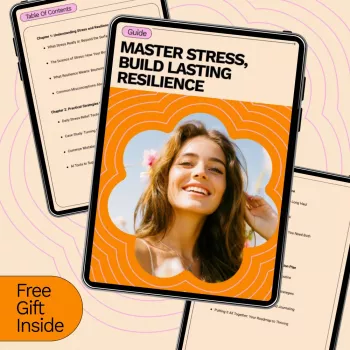
If you want step-by-step support, Master Stress, Build Lasting Resilience – Practical Guide on How to Manage Stress and Build Resilience for Everyday Life is designed to help you practice both quick calming methods and longer-term habits (sleep, boundaries, mindset, and recovery).
If screen time is a major driver of tension, eye strain, or headaches that amplify stress, pair it with Screen Headaches Solved – A Practical Digital Guide to Headaches From Screen Overuse, Eye Strain Relief & Smart Screen Habits to tighten up daily screen routines and reduce a common, preventable stress load.
FAQ
What is the fastest way to calm down when stress spikes?
Use a physiological sigh for 1–3 rounds (inhale, short top-up inhale, long exhale) to quickly reduce physical arousal. If you need steadier focus, do box breathing (4 in, hold 4, out 4, hold 4) for 1–5 minutes. If your mind is spiraling, use 5-4-3-2-1 grounding to pull attention back into the present.
How long does it take to build resilience?
Noticeable improvements can show up in days to weeks when you practice small skills daily, especially sleep consistency and quick regulation tools. Deeper changes—like faster recovery from major stressors—typically build over months through repetition and better recovery habits.
When should stress be addressed with professional help?
Seek licensed support if stress causes persistent impairment at work or home, panic attacks, severe sleep disruption, increased substance use, depression symptoms, or thoughts of self-harm. If you’re in immediate danger or considering self-harm, contact emergency services right away.
Recommended for you


How Nike Uses Emotion to Sell More Athletic Gear
Sep 24, 2026













Leave a comment